Change CSV Delimiter
A CSV file can open as one column when its separator does not match the setting used by the next tool. For example, a comma separated address list may need semicolons for a regional spreadsheet import. Change the delimiter while the rows stay the same, so fields that contain commas remain complete.
How the delimiter change works
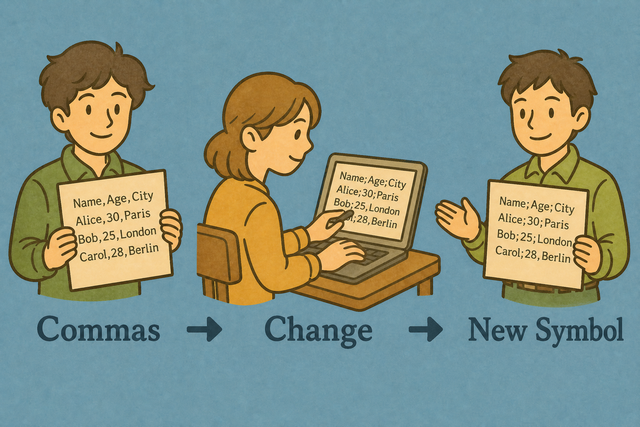
1. Add CSV data
2. Select a new delimiter
3. Copy or download the result
Supported Formats
Add CSV data
You can add data, upload a file, or use an example
Parsing Status
No CSV data to parse
You can add data, upload a file, or use an example
Rewritten CSV output
Change the column separator so another spreadsheet or data system can read the same rows correctly.
How to change a CSV delimiter
A CSV file may use commas while the receiving system expects semicolons, tabs, or pipes. This tool changes the separator in your browser, which keeps the table useful for the next import.
- You can add your data Paste CSV or upload a file. Local processing keeps the source data in this browser.
- You can set the separators Choose the current value separator and the new delimiter. Matching both settings lets quoted commas remain inside their fields.
- You can check the result Review the preview, then copy or download the CSV. A quick check helps catch a separator mismatch before import.
CSV delimiter basics
What is CSV?
CSV is a plain text table with one row per line and a separator between fields. A row such as Ada,36,London uses commas, while the same three fields can use semicolons or tabs when another system expects them. Because the file stores values rather than formulas or styling, matching the separator helps the receiving system read each column.
Sample input and output
Example input
Name,Age,City
Ada,36,London
Lin,29,Taipei
Example output
Name,Age,City
Ada,36,London
Lin,29,Taipei
Common delimiter problems
My spreadsheet needs semicolons.
A spreadsheet can place every value in one column when it expects semicolons but receives commas. Set New column delimiter to semicolon (;), because the output then matches that import convention.
Will leading zeros disappear?
A code such as "00123" can lose its first zeros after a spreadsheet interprets it as a number. Quoted values keep their zeros during conversion, while setting the destination column to Text protects them after import.
Why is everything in column A?
A file can appear in column A when its actual separator differs from the selected Current value separator. Choose semicolon or tab when the source uses that character, because the parser can then split each row into the intended fields.
What about UTF 8 and Windows 1252?
Accented text can look incorrect when the file encoding and the reader use different character sets. UTF 8 is a practical choice for shared CSV files, because it represents a broad range of characters consistently across systems.
Change CSV Delimiter FAQ
Does Change CSV Delimiter upload my file?
No. The CSV is processed in your browser, so the file is not sent to a server. This is useful when a customer list or export only needs a new separator and should stay on your device.
Can I convert comma CSV to semicolon?
Yes. Set the current value separator to comma and choose semicolon as the new delimiter. The rows stay the same, while the output uses the separator expected by the receiving spreadsheet or data system.
Are quotes updated for the new delimiter?
Yes. A field that contains the new delimiter is quoted in the output. This preserves the field as one value when the revised CSV is opened or imported.
How do I convert comma CSV to semicolon CSV?
You can set Current value separator to comma, then set New column delimiter to semicolon. A quick check of the output confirms that commas inside quoted fields remain part of those fields.
Will quoted commas stay inside fields?
Yes. The parser reads quoted fields before it writes the new separator, so a value such as "Doe, Jane" remains one field. This prevents an address or name from shifting into another column.
Can I change CSV delimiter to tab or pipe?
Yes. Choose Tab or Pipe (|) as the new delimiter and review the output. Tab works well for TSV style data, while pipe separates fields when commas and semicolons occur often in the values.